
2018-02-03
2018 Planning Approach: Print

I always use the new year to refresh my planning approach. The first step to this is recognizing the year's theme. For 2018, that theme is follow-through. One of my weaknesses is starting a project, but then getting excited and moving on to a new project before the first one is finished. I want 2018 to be all about follow-through and completion. My planning approach is vital to creating an environment where this theme can be successfully taken on. To align with the 2018 theme, I need to have a planning approach that focuses on accountability. The following is the approach I took toward designing my 2018 planning approach.
 The 4 pages for each week of the month consist of a weekly goals, reflections, and a weekly spread. The goals page is again just 10 things in the week that I'm aiming to get done, along with a celebrate section, so I can keep track of good things that happened in the week. The weekly reflection page is meant to be filled in at the end of the week.
It has 4 sections:
The 4 pages for each week of the month consist of a weekly goals, reflections, and a weekly spread. The goals page is again just 10 things in the week that I'm aiming to get done, along with a celebrate section, so I can keep track of good things that happened in the week. The weekly reflection page is meant to be filled in at the end of the week.
It has 4 sections: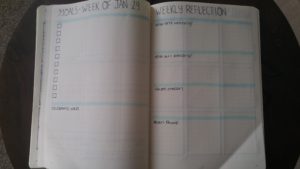
 The weekly spread breaks up each workday into morning, noon, and night. Of course, this is the area that I write appointments and meetings, but it's even more so the place that I write what I'm doing throughout the day. I'll get into this more later.
1. Review the Approach from the Previous Year
I had gone into 2017 underwhelmed by the success of my planning routine. My 2017 planning approach focused a lot on trial and error. I tried as many techniques as possible so that I could figure out what worked and what didn’t. I really appreciate that I took that action as it has helped a lot in solidifying an effective planning routine for 2018. This year I'm looking for consistency, and a more clear-cut approach. Last year, I used the 2017 Ink + Volt Planner for my scheduling. While I appreciated the goal planning approach, I wanted more reflection options and no journal prompts. My reasons for this were that, for me, accountability requires a lot of reflection, and I prefer journaling in a separate notebook. After reviewing everything, I knew that I needed 3 notebooks for my print planning approach: a planner, a day-to-day bullet journal, and a writing journal.2. Designing the Planner Spread
After taking time to search for other options, I found that no planner had everything that I was looking for. I decided to order a , and create the spread that I was looking for. My first page is an inspirational quote for the year that says, "Dreams don't work unless you do". I kept it simple by only having 4 pages for the overall year planning before the January 2018 spread started. The first page is a 2018 calendar view. The second page is an 'Important Dates' page. I decided to only sketch out the January spread, so that I could change my approach in February if I didn't like it. The 'Important Dates' page provides an area to jot down events for future months before their spreads are created. The 2 pages that follow are my 2018 goal-setting pages. They are absolutely identical to those found in the 2018 Ink + Volt Planner, so they deserve all of the credit for these. The first asks 3 questions:- What do you want to leave behind this year?
- What are the things you want to learn this year? How will you improve yourself in the year ahead?
- What would it look like if this year went perfectly? What would you have/be/do?
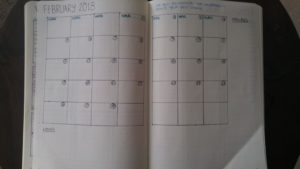
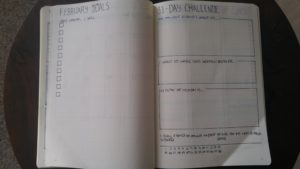
My monthly spread consists of 4 pages for the monthly overview and 4 pages for each week of the month. The 4 monthly overview pages consists first of a monthly spread. I keep this simple, and only add a motivating quote and a focuses section. Then there is a January goals area, and a monthly challenge page. The goals are simply a list of 10 items that I'm hoping to accomplish within the month. The monthly challenge page is where I list something I want to do for the next month, why I want to do it, what my plan of action is, and then a list of the number of days, so that I can circle them as I complete the challenge. This is another spread pretty much identical to the 2018 Ink + Volt Planner.
The 4 pages for each week of the month consist of a weekly goals, reflections, and a weekly spread. The goals page is again just 10 things in the week that I'm aiming to get done, along with a celebrate section, so I can keep track of good things that happened in the week. The weekly reflection page is meant to be filled in at the end of the week.
It has 4 sections:
- What isn't working?
- What am I avoiding?
- Values check-in
- Brain Dump
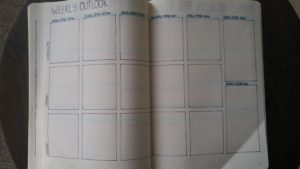
The weekly spread breaks up each workday into morning, noon, and night. Of course, this is the area that I write appointments and meetings, but it's even more so the place that I write what I'm doing throughout the day. I'll get into this more later.